Why Simple HTML and CSS is Still a Good Choice for Websites in 2026
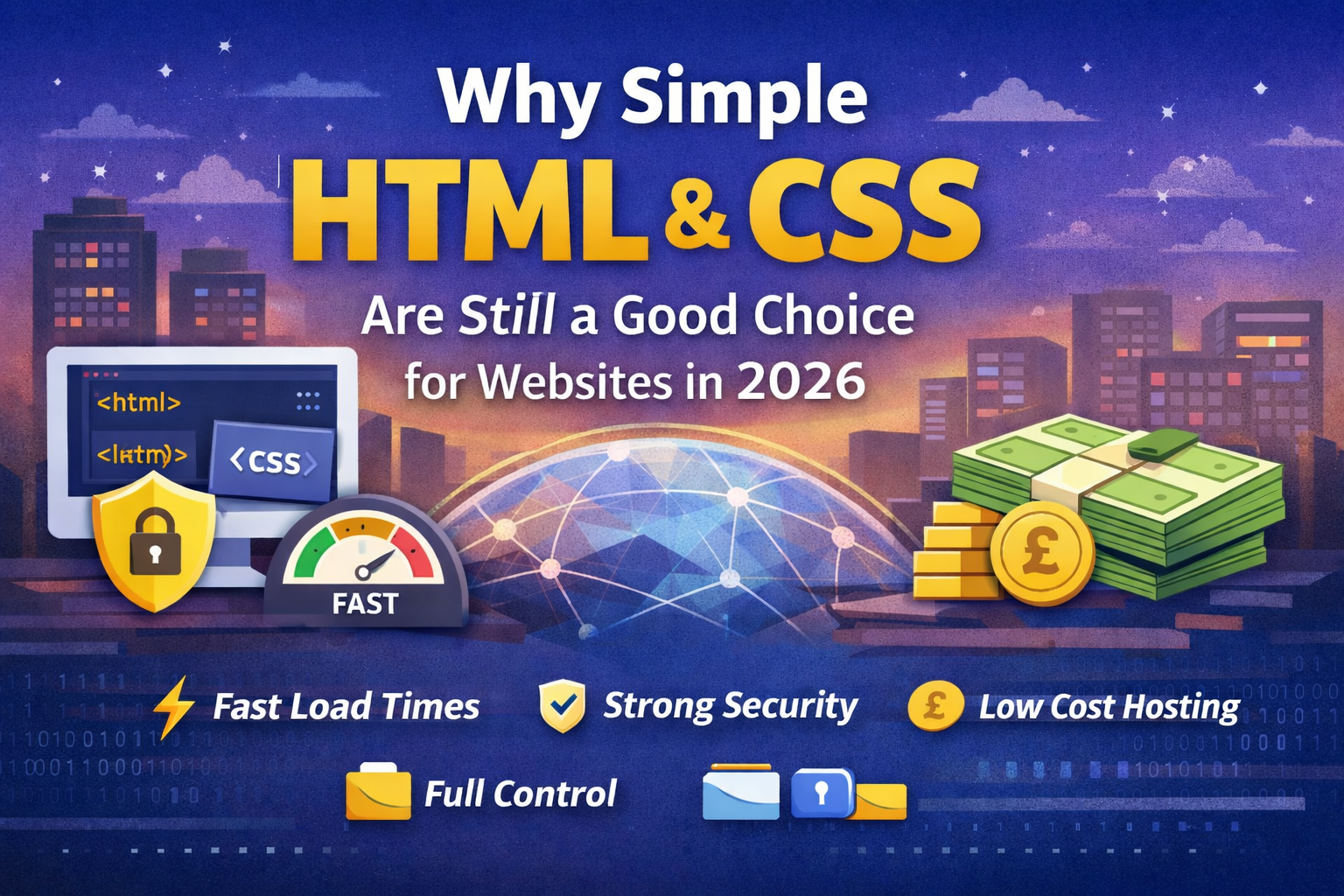
The simplest way to build a fast, secure, future-proof website
If you are thinking about building a website in 2026, you will probably be pointed toward website builders, no-code tools, or modern JavaScript frameworks. They promise speed and convenience, but they often come with trade-offs that are not obvious at the start.
Slower performance, monthly fees, limited control, long-term lock-in, and higher costs in later years are common side effects.
What many people do not realise is that one of the best options available is also one of the simplest. A website built with basic HTML and CSS (often called “vanilla” HTML/CSS), hosted on a modern static platform like Cloudflare Pages, is still a very strong choice for small businesses, personal websites, and landing pages.
What Do We Mean by a Static “Vanilla” Website?
A static website is made up of simple files:
- HTML files for structure and content
- CSS files for layout and design
- Image files for photos, backgrounds, and icons
- Optional small amounts of JavaScript for light interaction
Static websites do not depend on a database or a server-side application running in the background. When someone visits your site, these files are sent directly to their browser.
Platforms like Cloudflare Pages take those files and serve them globally using a CDN (Content Delivery Network). This means visitors receive your site from a nearby location, resulting in very fast load times without you managing any infrastructure.
1. Fast Websites Without Extra Complexity
Speed matters more than most people think. Visitors often leave slow websites, and search engines are less likely to rank them highly.
With a basic HTML and CSS website:
- Pages load almost instantly
- There is nothing to initialise before content appears
- What you write is exactly what the browser renders
When hosted on a global network such as Cloudflare, your site is delivered from the closest possible location to the visitor. For many users, pages load in milliseconds.
2. Reliability Through Simplicity
Static websites are reliable because there are very few things that can go wrong.
- No dependency on backend systems
- No required external APIs
- No database
- No complex software stack to maintain
Static hosting providers include automatic HTTPS, built-in DDoS protection, and global caching by default. Traffic spikes are handled without special configuration.
3. Security That Comes for Free
Security is often a concern for beginners, but static sites make this much easier.
A basic HTML and CSS site is more secure because it has:
- No user accounts
- No admin dashboard
- No plugins
- No backend code
- No server-side software stack
This removes a large number of common attack vectors used to compromise websites.
4. Little to No Ongoing Cost
Hosting a static website is one of the few areas in tech where you can still get world-class infrastructure for free.
Because static sites do not require server-side processing, many major providers offer generous free tiers.
Completely Free Tier (Ideal for Personal and Small Business Sites)
| Provider | Best For | Key Features |
|---|---|---|
| GitHub Pages | Beginners & Developers | Completely free, Git-based deployment |
| Netlify | Small Businesses | Drag-and-drop support, free forms, SSL |
| Cloudflare Pages | Speed & Security | Unmetered bandwidth, excellent DDoS protection |
These plans usually remain free unless you experience unusually high traffic or commercial usage.
Pay-As-You-Go (Pennies per Month)
If you want full cloud control without subscriptions:
- Amazon S3 + CloudFront: Extremely reliable, often under £1 per month for low traffic
- Google Cloud Storage: Similar pricing with a generous free tier
- Azure Static Web Apps: Good integration with Microsoft services
- Firebase Hosting: Simple deployment and strong free tier
- AWS Amplify: Similar to Firebase, backed by AWS
5. You Actually Own Your Website
When you build with HTML and CSS, your website is just files.
You can:
- Host it anywhere
- Move providers easily
- Keep it running for years without changes
There is no vendor lock-in and no proprietary system controlling your content.
6. Designed to Last
HTML and CSS are some of the most stable technologies on the web. Pages written decades ago still load correctly today.
Platforms and frameworks change quickly. Features are removed, templates break, and pricing models shift.
A simple static site avoids most of this churn and requires very little long-term maintenance.
7. Strong Foundations for SEO
Search engines prefer websites that are fast, readable, and clearly structured.
Static HTML supports this naturally. You control headings, links, and content directly without hidden abstraction layers.
Website builders often generate bloated markup and depend heavily on JavaScript, which can make pages harder for search engines to understand.
8. Better Privacy by Default
Static websites do not require cookies, trackers, or consent banners unless you choose to add them.
This makes privacy compliance much easier, particularly in the UK and EU. Privacy-friendly analytics can be added without tracking individual users.
Many website builders include tracking scripts that are difficult to fully disable.
9. Static Does Not Mean Limited
A static site can still include:
- Contact forms
- Basic interactivity
- SEO-friendly content pages
Modern edge services and serverless tools allow features to be added only when needed, without turning the site into a complex application.
10. Who This Approach Works Best For
HTML, CSS, and static hosting are ideal for:
- Portfolios
- Small business websites
- Landing pages
- Documentation
- Content-driven projects
They are not suitable for large, highly interactive applications, but most websites do not need that level of complexity.
Why Website Builders Are Still Popular
Website builders appeal because they promise speed and ease with no coding.
They can be useful if you prioritise convenience over control, performance, and long-term cost.
For anyone willing to learn a small amount of HTML and CSS, simplicity usually wins.
Final Thoughts
In 2026, building a website with simple HTML and CSS and hosting it on a platform like Cloudflare Pages is not outdated. It is a practical, modern choice.
You get faster load times, better security, lower costs, full ownership, and long-term stability.
Sometimes the simplest tools really are the best ones.